
Clearer Fit Checks for a Brass Clamp-in Truck Tire Valve Stem
Selecting a brass clamp-in truck tire valve stem starts with rim-hole fit, stem reach and service access; the straight TR570 provides a documented reference.
Start With the Wheel Interface
Wheel compatibility is the first selection gate. SSWYAUTO lists the TR570 for tubeless truck and bus tires, with a clamp-in metal construction and a straight stem. This describes an intended application, not approval for every vehicle carrying those tire types. A distributor should connect the product record to a specific wheel requirement before treating it as a replacement.
Confirm the Rim-Hole Requirement
The page gives a rim-hole size of 0.625 inch, also expressed as 15.7–15.9 mm. Buyers should retain that published notation in the evaluation record and compare it with the wheel documentation. The opening size is different from the stem diameter. A visual resemblance or a familiar model designation cannot replace a dimensional and material compatibility check.
Check Reach and Access
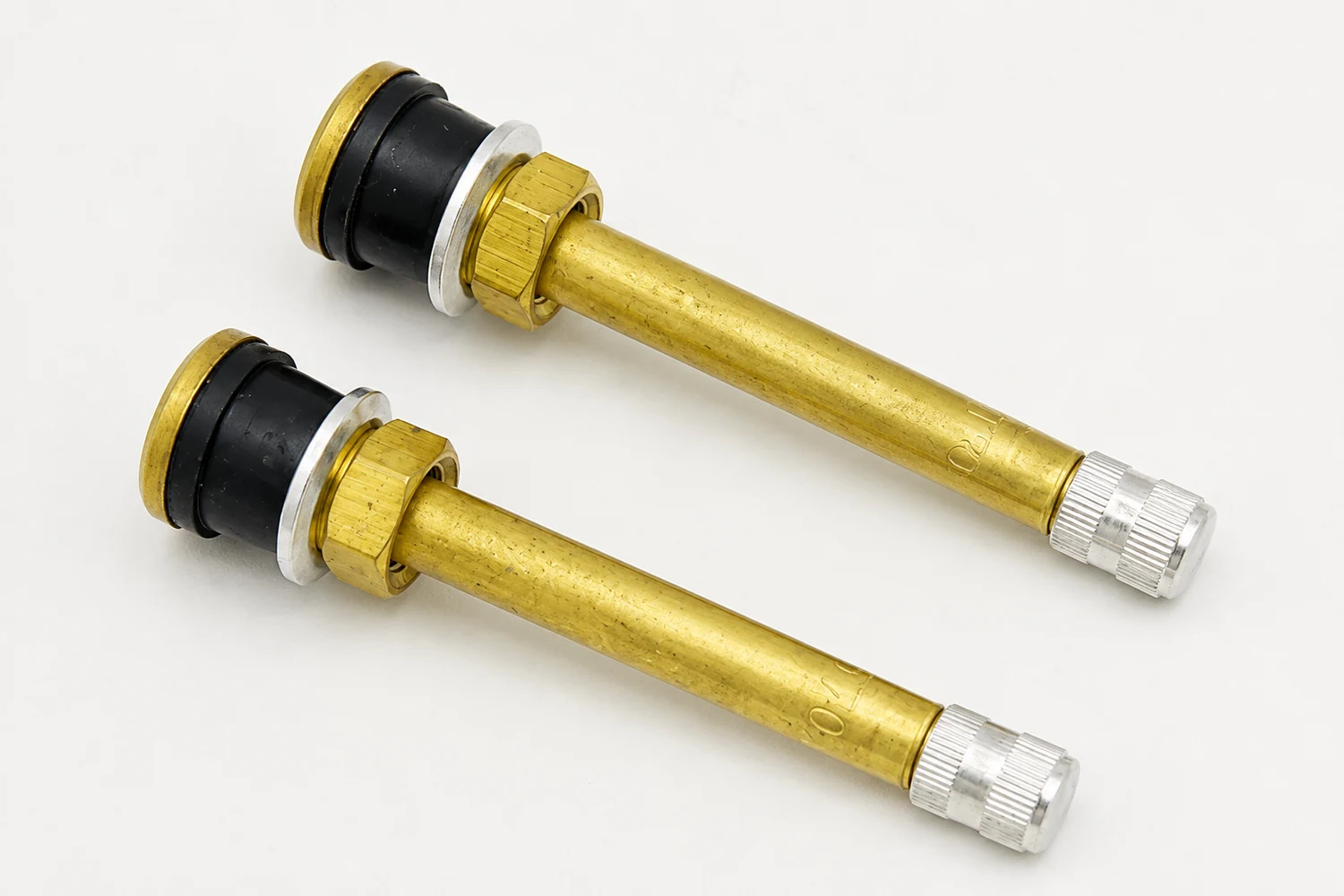
The straight TR570 has a declared angle of 0° and an approximate overall length of 83–84 mm. Those figures help frame a clearance review, but overall length is not automatically the exposed length after assembly. Access for a pressure gauge or inflation connection must be assessed on the actual wheel arrangement, without assuming additional extensions are included or approved.
Read the TR570 Dimensions Together
A useful specification review considers all dimensions as a group. The following table reproduces the selected model's published data and separates those values from the buyer's next checks. The product page also names TR570C; its separate configuration should not inherit the straight model's dimensions merely because both appear on one page.
| Decision factor | Verified TR570 data | Evaluation use |
|---|---|---|
| Valve design | Clamp-in metal valve; straight TR570, 0° | Match the approved wheel configuration and access direction. |
| Material | Brass + rubber | Confirm the specified metal finish and sealing assembly. |
| Rim-hole size | 0.625 inch / 15.7–15.9 mm | Compare with the actual wheel specification, not stem diameter. |
| Stem diameter | 7.8 mm | Check the dimensional drawing and surrounding clearance. |
| Base diameter | 19 mm | Review seating-space requirements with the wheel design. |
| Overall length | Approximately 83–84 mm | Evaluate reach without treating the approximate range as a manufacturing tolerance. |
| Listed application | Tubeless truck and bus tires | Verify the individual wheel fitment before service. |
The approximate length is a catalog description, not a stated acceptance tolerance. Where receiving inspection needs limits, measurement datums or a drawing revision, those details should be requested explicitly. This keeps a catalog reference from becoming an unsupported manufacturing specification in a purchase order.
Inspect the Complete Valve Assembly
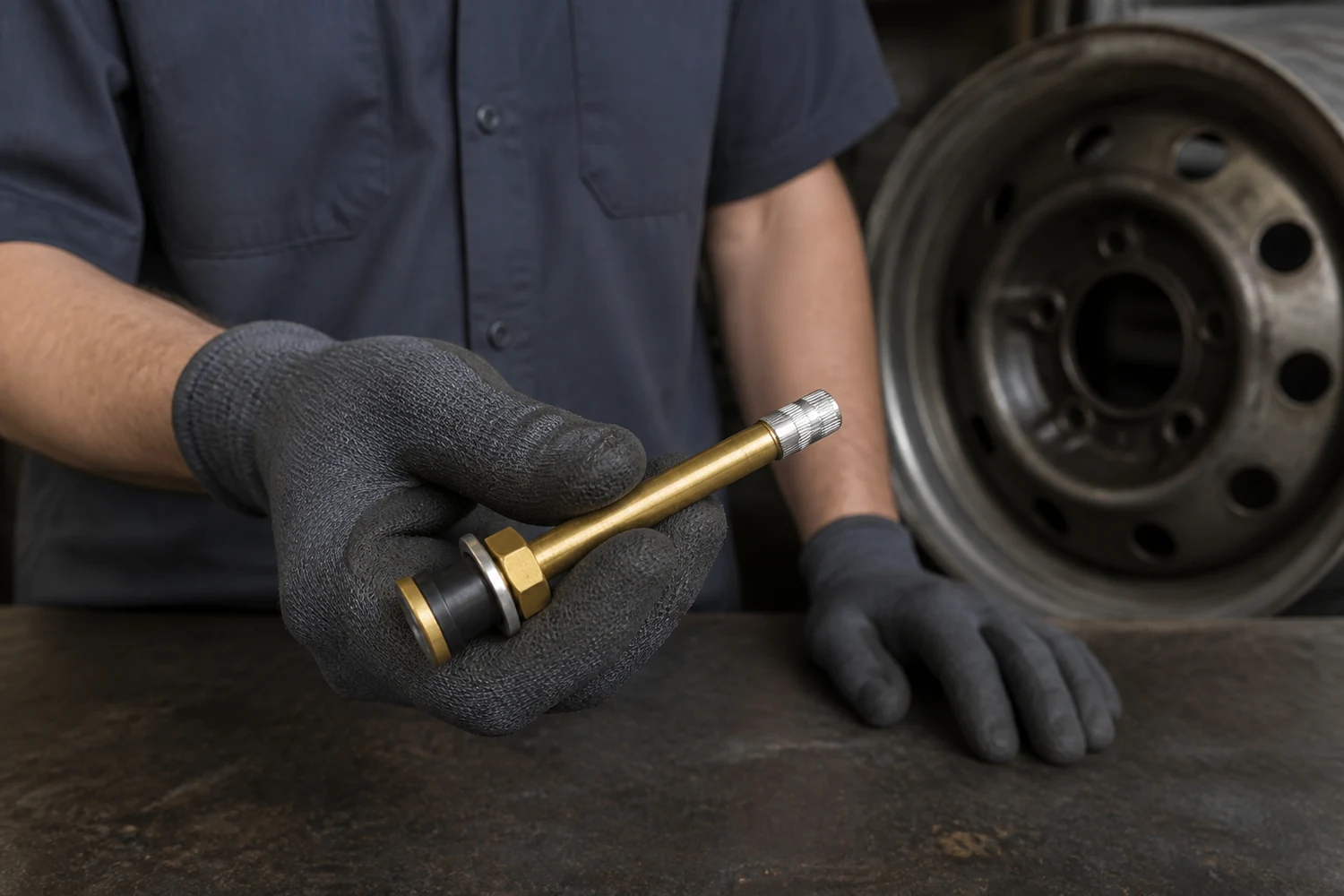
Assembly condition deserves attention alongside nominal size. The verified material description is brass plus rubber, and the source photograph shows the straight brass shaft with its fitted sealing and fastening components. A buyer evaluating a brass clamp-in truck tire valve stem should compare the complete approved sample with the delivered configuration, not judge the shaft alone.
Review the Sealing Components
A visual inspection can flag damaged rubber, distorted parts or a visibly different assembly, but it does not establish airtight performance. The sealing arrangement and its compatibility with the wheel need documented confirmation. The basic material entry does not independently establish temperature limits, chemical compatibility or a service-life guarantee, so these should not be inferred from appearance.
Keep Finish Requirements Explicit
The wheel manufacturer's material restrictions remain important even when the dimensions appear suitable. A brass-colored photograph does not prove that a particular surface treatment meets an application requirement. Buyers should record the required finish and seek confirmation for the intended wheel rather than assuming compatibility with every steel or aluminum wheel design.
Plan a Controlled Workshop Handoff
The selection record should remain usable when the component reaches a workshop. The product page identifies fleet maintenance and tire-service work as relevant contexts. Clear model identification and an agreed fitment record help the service team know which component was evaluated, while leaving the installation decision with trained personnel.
Separate Receiving Checks From Installation
At receiving, staff can compare the model, overall form, specified dimensions and visible assembly against the approved documentation. Any mismatch should be resolved before the item enters service stock. This is an inventory-control step, not a pressure test or an installation instruction, and it should not be presented as proof that the valve is suitable for an unverified wheel.
Use the Applicable Service Procedure
Truck tire and wheel servicing can be hazardous and should be performed only by trained personnel using the applicable manufacturer's procedure and appropriate equipment. This article supplies no tightening torque or inflation setting. The page's reference to wheel balancing is a downstream service context; balancing is not evidence of valve sealing or a substitute for the required inspection.
Keep Supply Specifications Consistent
For commercial vehicle service buyers, a clear purchasing record is more useful than a broad promise of universal compatibility. Record the straight TR570 model, intended wheel reference, dimensional requirements and agreed assembly details together. This gives procurement and workshop teams a shared basis for reviewing samples and clarifying differences before replenishment.
The product-specific page describes private-label or OEM/ODM supply, including labeling and packaging options. Those are subjects for confirmation, not proof of a particular pack quantity, delivery schedule or minimum order. Any branding request should remain separate from the technical fitment decision, with the approved component specification held consistent throughout the discussion.
Sample review should also distinguish a cosmetic variation from a functional change. If a proposed finish, sealing component or packaging configuration differs from the agreed record, ask for an updated description before approval. A documented revision is easier to compare across suppliers and shipments than a verbal assurance that the replacement is equivalent.
Use a Short Evaluation Checklist
A repeatable review makes the decision traceable without turning a catalog into a workshop manual. Buyers can use the following sequence to organize questions for the supplier and service team. Each unresolved point should remain open in the evaluation record rather than being silently filled with a value from a similar valve.
- Identify the exact configuration. Specify the straight TR570 and the intended wheel, avoiding an undifferentiated request for the entire product family.
- Compare the interfaces. Review rim-hole size, base seating space, stem reach and access against the wheel documentation.
- Confirm the assembly. Agree the material, surface finish and supplied sealing and fastening components in the sample record.
- Resolve missing limits. Request the applicable technical instructions and acceptance criteria before service approval; do not import another manufacturer's settings.
- Close the documentation loop. Keep the approved sample reference, purchasing description and receiving checks aligned before repeat orders.
Frequently Asked Questions
What application does the TR570 listing support?
The corroborated application is tubeless truck and bus tires. The page also places the product in commercial vehicle maintenance contexts. These descriptions establish the intended category, but the actual wheel design and its manufacturer's requirements determine whether a particular fitment is acceptable.
Is the rim-hole size the same as the stem diameter?
No. The listed rim-hole size is 0.625 inch / 15.7–15.9 mm, while the stem diameter is 7.8 mm. They describe different parts of the interface and should remain separate fields in a dimensional review rather than being used interchangeably.
Can the straight model's length be applied to TR570C?
No. The approximate 83–84 mm overall length recorded here belongs to the straight TR570 data. A related name on the same product page is not enough to transfer a dimension. Buyers evaluating another configuration should use that configuration's confirmed drawing and specifications.
Does the material description establish a pressure rating?
No. Brass plus rubber identifies materials, not a complete operating envelope. Pressure, temperature and installation requirements need appropriate model-specific documentation and wheel compatibility confirmation. This guide does not adopt a pressure claim from promotional text as an independently verified operating limit.
What should a distributor request before approving stock?
A distributor should request confirmation of the intended wheel fitment, the supplied assembly and any missing dimensional acceptance criteria. Where private-label packing is needed, the agreed labeling and packaging should be documented separately. Approval should follow the evidence review, not replace it.
Complete the TR570 Fitment Review
The next step in evaluating a brass clamp-in truck tire valve stem is to compare the intended wheel requirements with the published TR570 product details. Share any unresolved interface, assembly or documentation questions with SSWYAUTO before approving the component for the planned application.