
Application Review for a 35-Piece Tire Repair Tool Kit
A 35-piece tire repair tool kit supports temporary tread-puncture response, but buyers should separate kit completeness from permanent repair procedure.
What the Product Page Actually Establishes
The selection decision starts with a bounded set of documented facts. The page identifies a 35-piece set, a black storage case, T-handle tools, tire-plug repair, and steel, alloy, and rubber among the tool materials. It also describes the case as durable plastic and lists professional tire repair and emergency repair as the usage. These details establish what can be compared during sourcing without turning broad promotional language into an unsupported technical promise.
Verified set identity
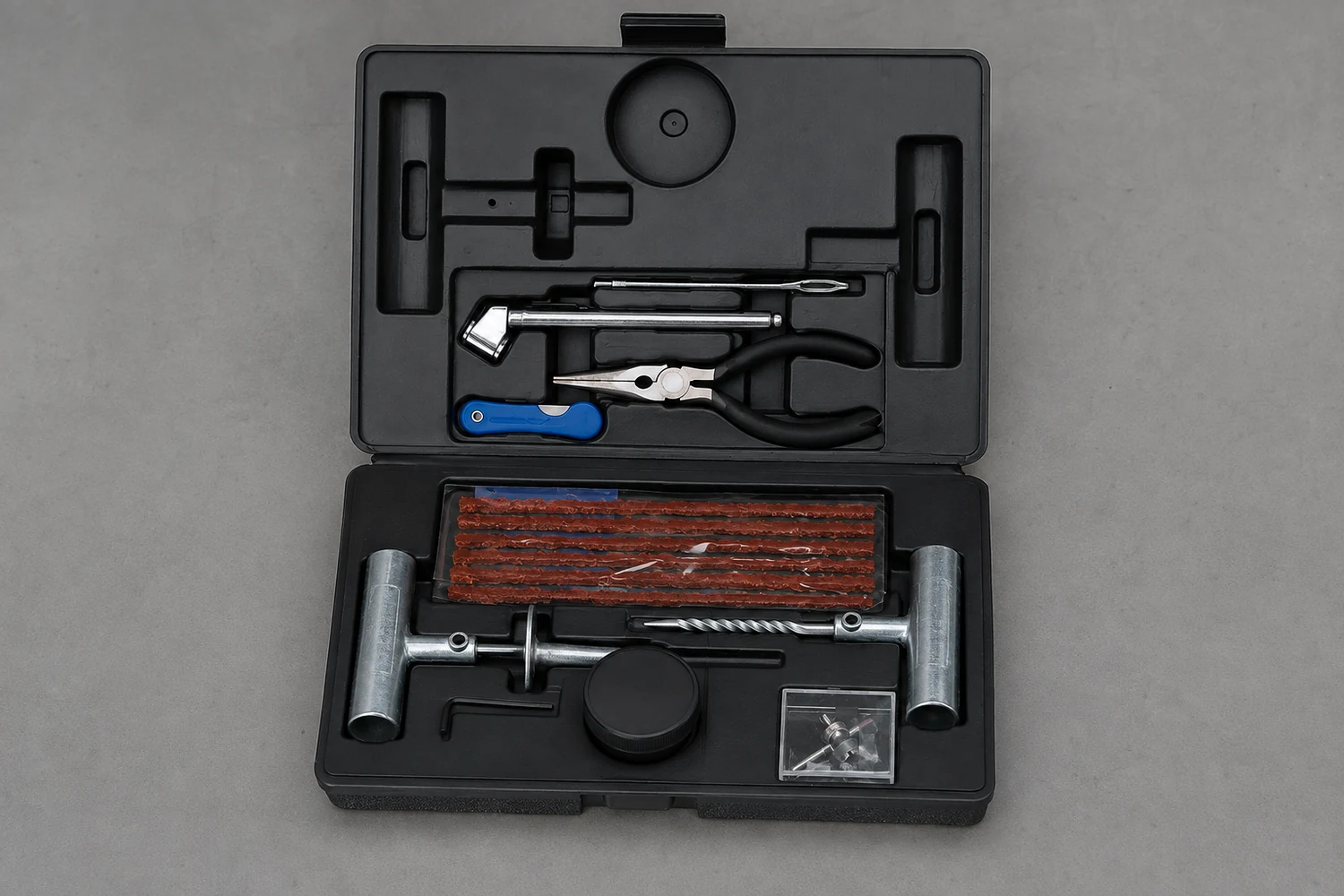
A buyer reviewing the 35-piece tire repair tool kit should first reconcile the delivered count against the approved sample and packing list. The product page says the set contains essential plugging tools, repair strips, insertion tools, and a portable case, yet it does not publish a line-by-line quantity for every accessory. A responsible purchase specification should therefore define the accepted component schedule instead of assuming that every market version uses the same internal arrangement.
The T-handle format is a useful functional identifier because the page connects it with grip and torque during puncture cleaning and plug insertion. That statement supports a handling discussion, not a guarantee that every technician will achieve the same result. Tool condition, puncture geometry, tire construction, and operator training remain relevant to the service outcome.
Materials and storage
Documented tool materials include steel, alloy, and rubber, while the case is described as durable plastic. For procurement, those labels are starting points for inspection rather than complete material grades. Incoming checks can compare visible finish, burrs, cracks, handle attachment, strip condition, and case closure against an approved sample. The product page itself describes visual and specification inspection for part quantity, size, burrs, and cracks.
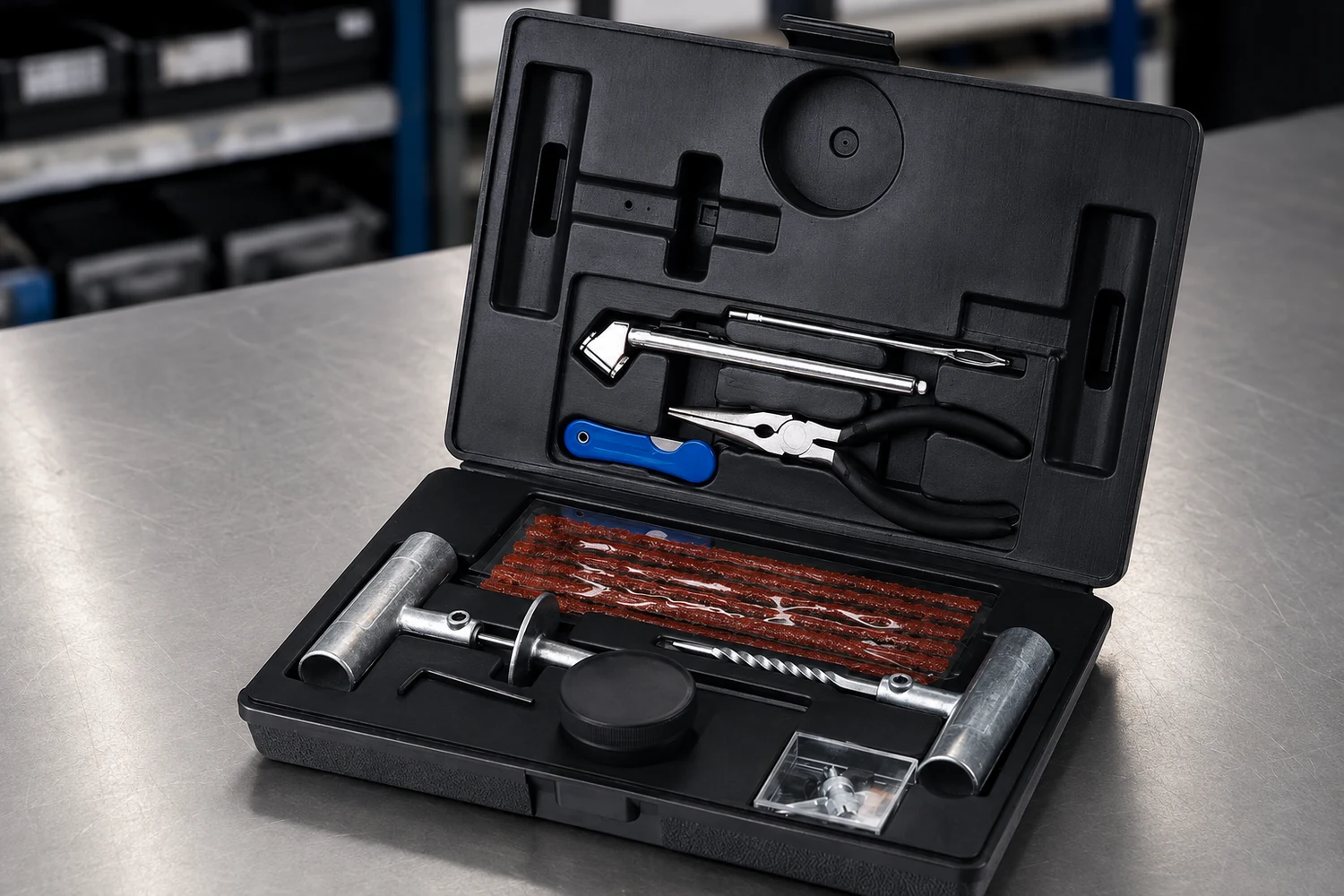
The black case contributes organization and portability. Buyers can review whether each item remains seated during normal handling, whether the case closes consistently, and whether the layout makes missing pieces easy to identify. The page does not specify case dimensions, so storage-space claims should wait until a physical sample is measured.
Separate Emergency Use From Permanent Repair
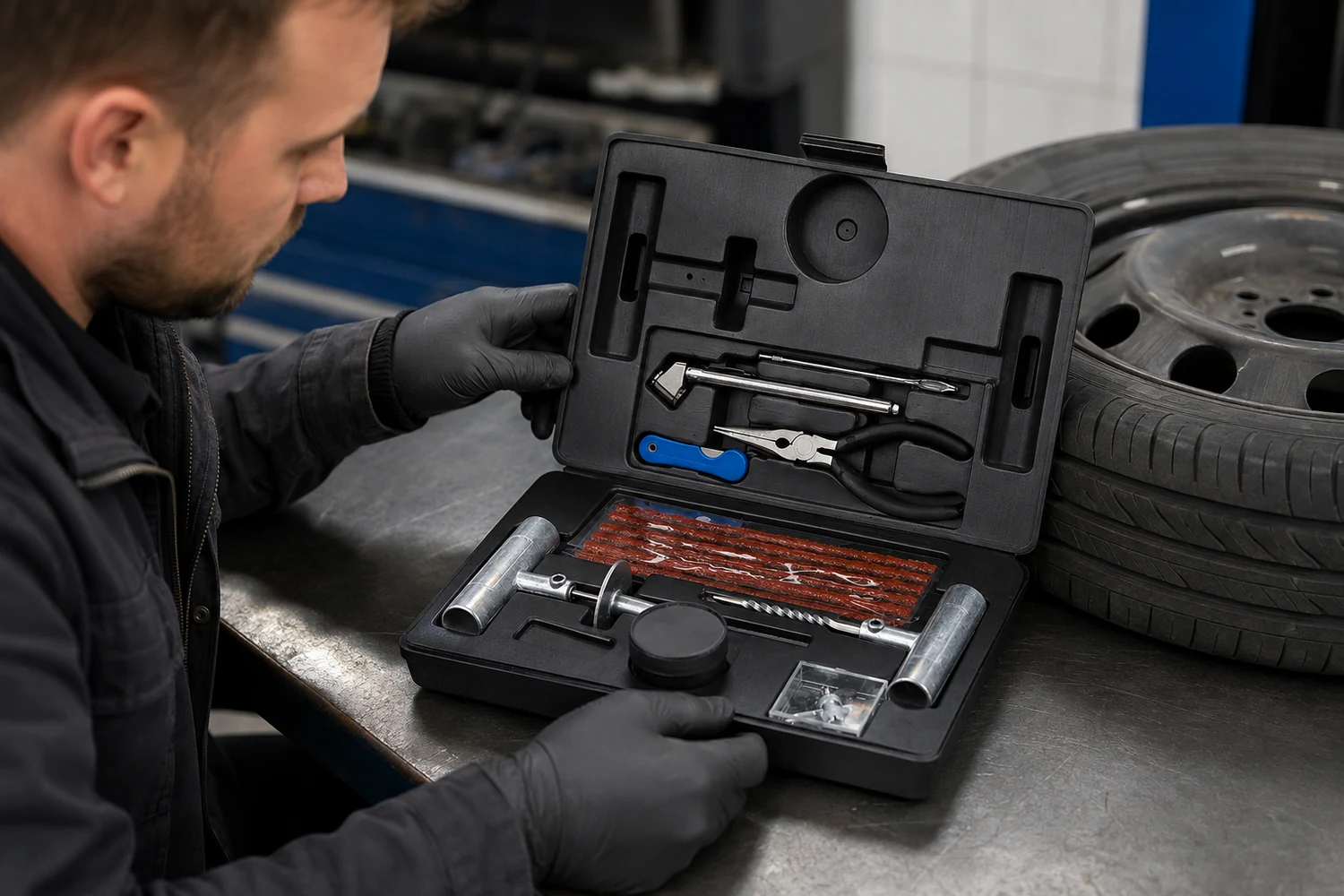
The product page frames the plug process as temporary emergency support. It says a puncture can be cleaned, a repair strip inserted, excess material trimmed, and pressure restored for short-distance driving. The same page advises low-speed, short-distance use and a professional maintenance visit as soon as possible. That limitation should remain visible in product instructions, distributor training, and buyer evaluation.
Emergency use is a constrained application
A portable plug kit may help respond to a minor tread puncture, but the presence of tools does not establish that a particular tire is repairable. Injury location, internal damage, prior repairs, inflation history, and tire-maker restrictions all affect the decision. The selected page specifically warns that sidewall repairs are not for long-term use and calls for pressure monitoring after the temporary action.
Current U.S. tire-industry guidance also distinguishes an outside-in plug from a complete repair. It calls for removing the tire from the wheel, inspecting the inside, limiting repairs to eligible tread-area injuries, filling the injury, and sealing the inner liner with a patch. This general context does not change the kit specification; it explains why marketing should not describe a temporary plug operation as a finished permanent repair.
Permanent procedure remains a service decision
Service businesses need written rules for escalation. A technician should stop when the injury lies outside the permitted repair area, when internal inspection shows additional damage, or when the relevant tire policy excludes repair. The kit page cannot answer those tire-specific questions. It can only establish the supplied tool format and the temporary-use message that accompanies it.
For sourcing teams, this boundary affects claims review. Packaging and sales copy should explain the intended temporary role, avoid blanket compatibility statements, and direct users toward professional inspection. Clear limitations protect the usefulness of the kit because buyers can place it in the correct workflow instead of expecting it to replace full workshop repair equipment.
Match the Set to the Operating Context
Application review should focus on how the portable set will be stored, checked, issued, and replenished. The product page lists tire shops, auto-repair workshops, fleet maintenance, roadside emergency response, auto-parts stores, and do-it-yourself vehicle maintenance. Those use cases do not prove compatibility with every tire; they identify buyer environments in which a controlled temporary-response kit may be relevant.
Workshop and passenger-vehicle review
For passenger vehicle service, the portable case can be evaluated as an intake or emergency-response resource before a full inspection. A workshop buyer can check handle comfort, insertion-tool alignment, strip condition, case organization, and instruction clarity on the approved sample. The purchase document should also state which consumables need replenishment and which damaged tools require replacement.
For tire shop and workshop supply, pack consistency may matter as much as the sample appearance. A distributor can ask for a confirmed component schedule, packaging inspection criteria, and batch-level visual checks. The page describes raw-material sampling, finished-product performance tests, full visual and specification inspection, and a packaging sealing test, but it does not publish test methods or acceptance thresholds. Those details need agreement during supplier review.
Fleet inventory control
In fleet maintenance, a kit can be assigned to a vehicle, depot, or service unit only after the operator defines inspection and replacement routines. Inventory checks can verify that the T-handle tools, repair materials, and case are present and usable. A sealed or numbered checklist can make missing parts visible before an emergency, although the selected product page does not promise any specific checklist format.
Fleet policies should identify when personnel may use a temporary response and when a tire must be removed from service. That decision belongs to the fleet, tire manufacturer, and applicable repair guidance. The kit should sit inside that policy, supported by training and pressure checks, rather than become the policy by itself.
Build a Comparable Procurement Specification
A useful request for quotation turns page evidence into comparable fields. The following table separates verified information from the additional checks a buyer may define. It does not add grades, dimensions, certifications, vehicle coverage, or performance limits that the product page has not established.
| Decision factor | Verified evidence | Buyer implication |
|---|---|---|
| Set identity | 35 pieces | Approve a component schedule and verify delivered count. |
| Handling format | T-handle | Review grip, attachment, alignment, and sample operation. |
| Materials | Steel, alloy, and rubber tools; durable plastic case | Define visible-finish and case-condition criteria. |
| Repair type | Tire plug repair | Keep temporary-use limits separate from permanent procedure. |
The table also reveals what remains open. Exact alloy grades, individual tool dimensions, strip quantities, packaging measurements, and acceptance thresholds are not stated in the verified page data. A buyer can request those items for a sample or quotation review without presenting them as current product facts.
Use a Disciplined Sample and Batch Review
A practical evaluation sequence keeps the decision evidence-based. It should confirm the 35-piece tire repair tool kit as delivered, test only within an approved procedure, and preserve the distinction between product inspection and tire-service authorization.
- Confirm identity: compare the product name, piece count, black case, T-handle format, and repair type with the approved record.
- Inventory the set: document every tool and consumable instead of relying on the headline count alone.
- Inspect condition: check visible finish, burrs, cracks, handles, rubber materials, and case closure.
- Review instructions: ensure temporary-use language, pressure monitoring, professional follow-up, and repair limitations are clear.
- Define batch checks: agree on count verification, sampling, packaging integrity, and disposition of nonconforming sets.
This sequence gives distributors and service buyers a repeatable basis for comparison. It also limits claim drift: the approved article, social copy, specification sheet, and packaging can all refer back to the same verified attributes and the same temporary-use boundary.
Frequently Asked Questions
Is the full quantity of each component published?
No. The page verifies a total of 35 pieces and identifies major tool and material categories, but it does not provide a complete quantity breakdown for every item. Buyers should approve a component schedule before relying on the set count for receiving inspection.
Does the kit create a permanent tire repair?
The selected page describes the plug operation as temporary emergency support for short-distance driving and advises professional maintenance promptly afterward. Industry procedures for complete repairs add eligibility checks, tire removal, internal inspection, and inner-liner sealing.
What tool format is documented?
The page documents T-handle tools and connects them with puncture cleaning and plug insertion. It does not publish exact handle dimensions or material grades, so those details should be checked on a physical sample if they matter to the buying specification.
Which storage details are verified?
A black storage case made from durable plastic is documented. The page describes portability, but it does not state case dimensions. Buyers can verify closure, organization, component retention, and measured size during sample review.
What should a distributor confirm before ordering?
The confirmed component schedule, visible-finish criteria, case requirements, instruction language, temporary-use warnings, batch sampling method, and packaging acceptance rules should be aligned. Any vehicle-coverage or performance claim also needs separate documented evidence.
Review the Set Against a Clear Requirement
Automotive aftermarket buyers can use the verified product page to compare set identity, materials, storage, inspection needs, and temporary-use messaging before requesting a focused supply discussion.