

Clearer Fit Checks for a TR574 truck tire valve stem
A TR574 truck tire valve stem should be screened by rim-hole size, stem length, wheel access, material, and documented service requirements before approval.
Establish the Verified Product Record
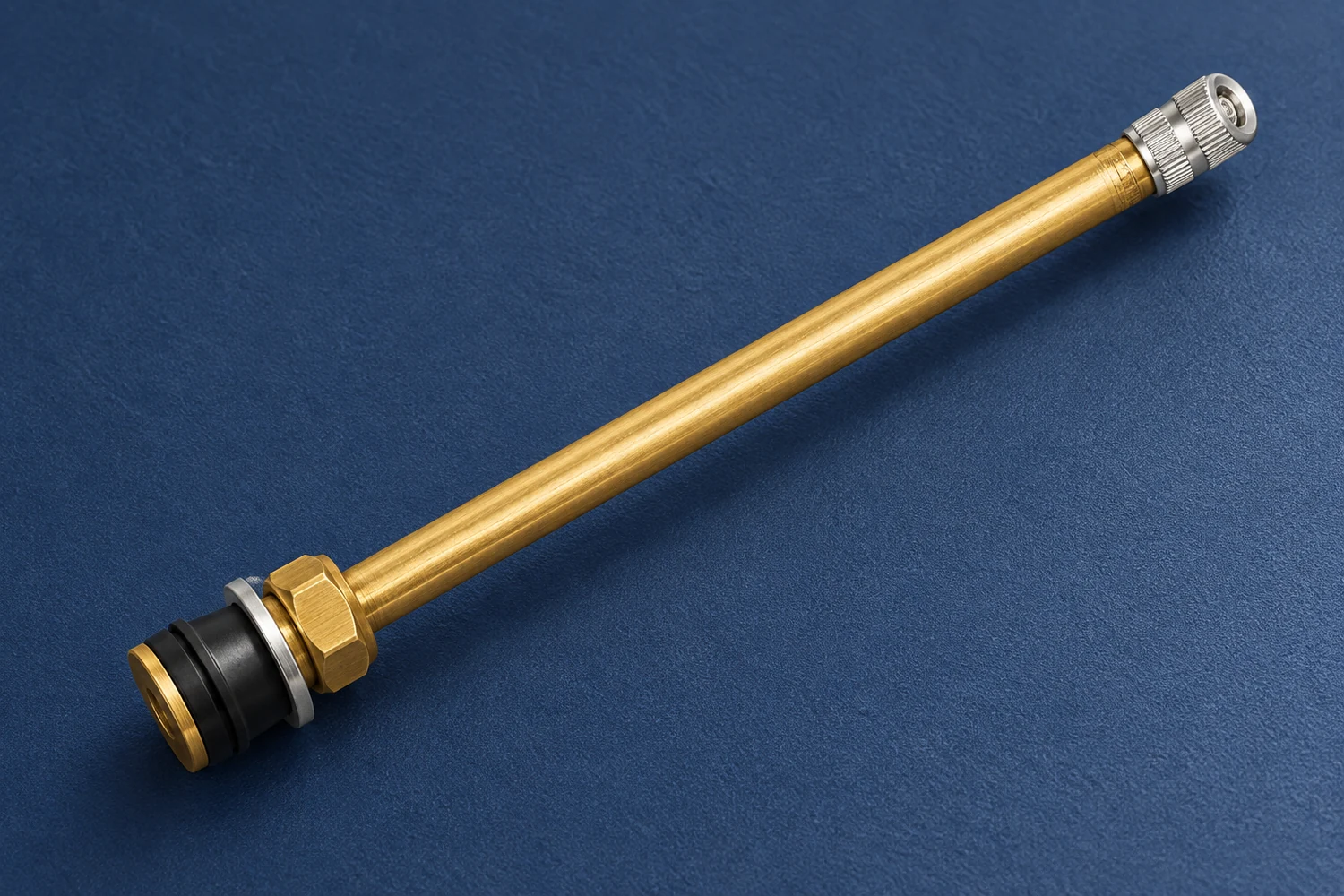
The selected product page identifies model TR574 as a clamp-in tubeless valve stem made from brass. It documents a straight long-stem configuration, an approximate length of 5 inches or 133 mm, a 0.625-inch rim-hole size, and an approximate base diameter of 19 mm. Those values create a useful evaluation record, but they are not a universal fit declaration. A buyer still needs to connect every value to the exact wheel, service method, and supplied assembly.
Separate identity from broader performance claims
The page supports a clear identity: TR574, brass material, clamp-in tubeless construction, and a straight long stem. It also supports truck, trailer, and bus tire applications. It does not provide a complete drawing, installation torque, thread dimensions, cap specification, sealing-component material, pressure rating, test method, or wheel approval list in the corroborated record. Those missing items should remain open questions instead of being filled with values from similar-looking valves.
Keep the model and measurement record together
The TR574 truck tire valve stem page provides both inch and metric length information, which helps international teams recognize the same declared dimension. Procurement records should preserve the approximate qualifier and identify whether the measurement covers the complete component or a defined exposed portion. The 19 mm base diameter and 0.625-inch hole statement should also remain separate fields so receiving teams do not substitute one for the other.
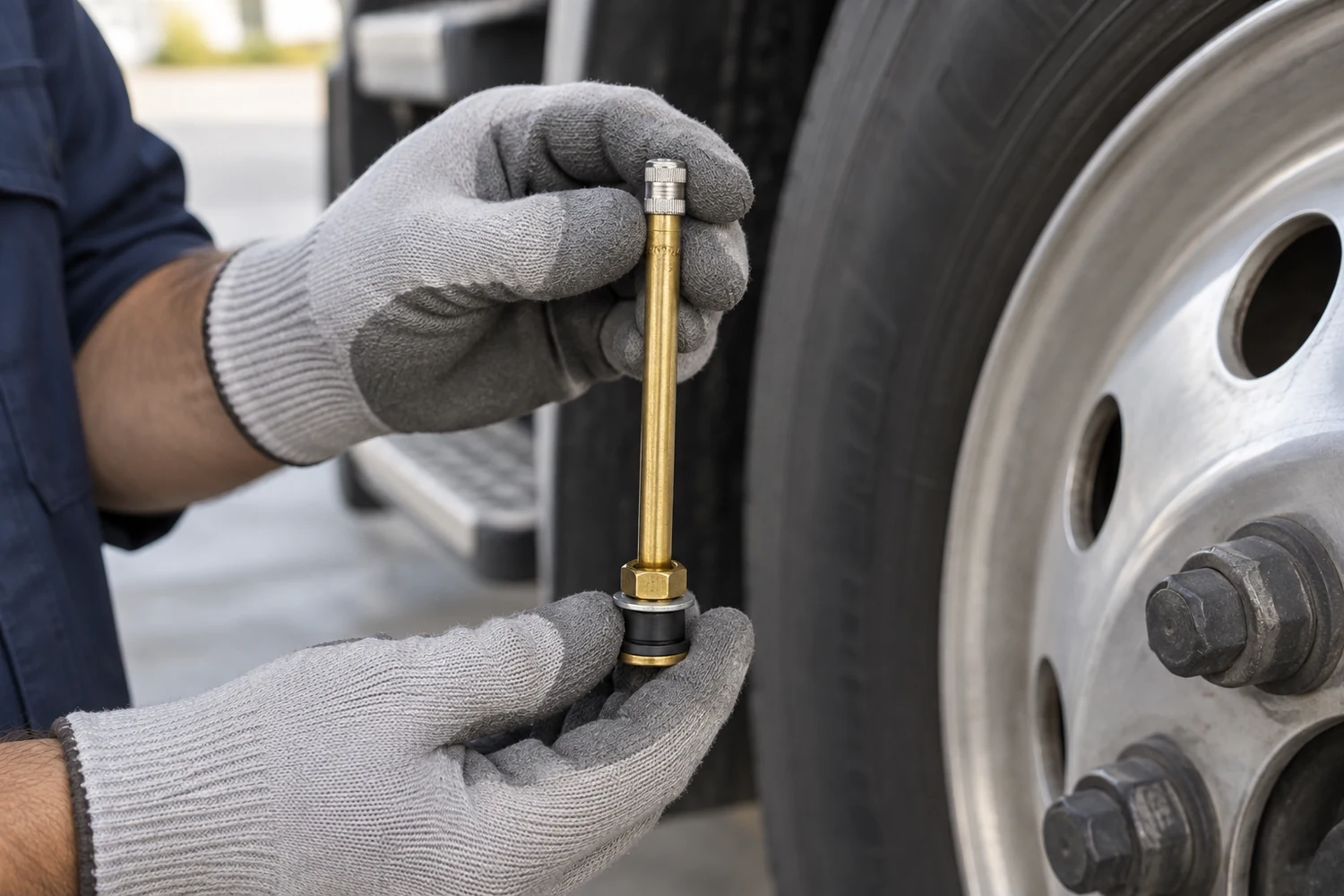
Match the Valve to the Wheel Interface
Correct selection starts with the wheel record, not with a visual comparison. The listed 0.625-inch rim-hole size is an important screening value, yet nominal hole size alone does not establish the condition, profile, thickness, seating surface, access path, or manufacturer approval of a wheel. Buyers should identify the wheel part number, obtain the applicable rim manual, and compare the approved valve arrangement before treating the product as a replacement candidate.
Check the hole, seating area, and access path
A sample review should examine the rim hole for deformation, corrosion, burrs, contamination, and damage before assembly. It should also confirm that the nut, washer, grommet, cap, and any other supplied parts match the approved build. The straight 133 mm stem must remain accessible to the intended gauge or air chuck without creating contact with nearby wheel, brake, hub, or tire surfaces. These are application checks, not performance claims about the product.
The brass clamp-in valve stem description helps distinguish this product from a rubber snap-in design, but material and installation family still do not replace a complete fitment decision. A controlled record should show the valve model, wheel model, verified hole specification, parts included, approved orientation, service reference, and sign-off result. That record is more useful for repeat purchasing than a photograph or a generic description such as long truck valve.
Plan Access Within a Controlled Service Workflow
The long straight configuration can be evaluated for access, but only the installed wheel assembly shows whether the location is practical. For a TR574 truck tire valve stem, the service team should verify that routine pressure checks can be performed with the approved equipment and that the installed component remains clear of moving or contacting surfaces. The evaluation should cover the actual vehicle or an approved wheel fixture rather than a loose valve alone.
Treat mounting and inflation as qualified work
Commercial rim-wheel work requires trained personnel, suitable tools, and the applicable wheel and tire instructions. The assembly should be deflated before relevant disassembly, inspected before reuse, and handled with the protective equipment and controlled inflation procedure required for that wheel type. This article does not replace a rim manual, tire-maker guidance, workplace rules, or technician training. Its role is to help buyers define what evidence must accompany product approval.
For commercial vehicle service programs, access is only one acceptance point. Teams should also verify sealing after installation, confirm that the cap and core arrangement match the approved specification, document the inspection method, and record any nonconformance. In fleet maintenance, linking each fitted valve to the wheel and service record can support consistent replacement decisions without assuming that one valve fits every truck, trailer, or bus wheel.
Compare Application and Procurement Evidence
The verified application statement covers tubeless truck, trailer, and bus tires. That scope gives distributors and service buyers a market context, while the exact wheel still controls the technical decision. A practical comparison keeps verified evidence in one column and buyer action in another, making it harder for a general application label to become an unsupported compatibility promise.
| Decision factor | Verified evidence | Buyer implication |
|---|---|---|
| Product identity | TR574; brass clamp-in valve stem | Keep model, material, and installation family on the purchase and inspection record. |
| Declared dimensions | Approx. 5 inches or 133 mm; 0.625-inch rim hole; approx. 19 mm base | Confirm measurement definitions, wheel interface, and access on an approved sample. |
| Application | Tubeless truck, trailer, and bus tires | Use the label for market screening, then approve against the exact wheel record. |
| Operating context | Commercial vehicle service and fleet maintenance | Define training, service documentation, inspection, and traceability requirements. |
Private-label or OEM/ODM discussions can cover supply requirements because that use case is explicitly listed. The commercial agreement should be kept separate from technical approval. Buyers can request current details for marking, packaging, documentation, order quantity, sample availability, production timing, and inspection, but none of those terms should be assumed from the dimensional record alone.
Build Sample and Receiving Checks
A sample plan turns the page evidence into repeatable acceptance steps. The plan should use the same fields for the first sample, approved reference, purchase order, receiving inspection, and any later change review. If a required characteristic is not in the verified page record, the buyer should request it in writing and add it only after confirmation.
- Confirm identity: record TR574, brass material, clamp-in tubeless type, and straight long-stem configuration.
- Define measurements: retain the approximate 133 mm length, 0.625-inch hole statement, and approximate 19 mm base as separate checks.
- Inspect the wheel: verify the exact part number, manual, hole condition, seating area, access, and approved valve arrangement.
- Review the assembly: identify every supplied component and confirm orientation, clearance, installation method, and sealing inspection.
- Lock the record: attach the approved sample, inspection method, packaging requirement, traceability field, and nonconformance process.
Receiving teams should compare a batch with the approved reference instead of relying only on the carton label. Useful checks can include model marking, overall configuration, declared dimensions, visible material and finish, included parts, thread condition, surface damage, contamination, and packaging separation. Functional or sealing tests should follow the agreed method and safe equipment. Any change to a dimension, component, or pack should trigger review before release.
Frequently Asked Questions
Which TR574 specifications are verified?
The selected page verifies a brass clamp-in tubeless valve with a straight long stem, approximate 5-inch or 133 mm length, 0.625-inch rim-hole size, approximate 19 mm base diameter, and applications for tubeless truck, trailer, and bus tires.
Does the listed hole size prove wheel compatibility?
No. The nominal hole statement is one screening field. Compatibility still depends on the exact wheel specification, condition, seating geometry, thickness, access, approved valve arrangement, supplied parts, and the applicable manufacturer or rim-manual instructions.
Why preserve the word approximate for dimensions?
The source uses approximate language for the length and base diameter. A buyer should retain that qualifier until a controlled drawing, tolerance, and measurement method are confirmed. Removing it would make the published evidence appear more precise than it is.
Where can this valve be evaluated?
The product record lists tubeless truck, trailer, and bus tire applications. It also supports wheel balancing, commercial service, and fleet maintenance contexts. The exact wheel must still be approved individually, and service work should be performed by trained personnel under the relevant procedures.
What should a repeat-purchase record contain?
Keep the approved valve and wheel models, defined dimensions, complete supplied assembly, installation reference, inspection method, packaging, traceability, change-control rule, and acceptance result together. That record gives procurement and receiving teams a consistent basis for future orders.
Review TR574 Against the Intended Wheel
Use the verified TR574 truck tire valve stem record to prepare a sample request covering the exact wheel, interface, access, supplied parts, inspection, documentation, marking, and packaging requirements.